.svg)

Risk of Planning Refusal
If planning is refused, value is not increased and the site can be negatively impacted for future sale. In most cases, you only get one strong opportunity to secure the right outcome.
We secure planning for your land at our cost, using our experience to manage the full process and maximise the sale price of your land.
Get a Free Land AppraisalWe secure planning for your land at our cost, managing the entire process to resolve constraints, establish a clear planning position, and bring the site to market in a way that drives higher offers and a stronger sale price.

If planning is refused, value is not increased and the site can be negatively impacted for future sale. In most cases, you only get one strong opportunity to secure the right outcome.

When developers are buying a site without planning, they work with conservative assumptions on what can be built, meaning the site is not used to its full potential.

Even after agreeing a price, buyers frequently revisit the deal after due diligence, using new information to negotiate down the final figure.
.avif)
Typically the highest value use of land, covering infill, settlement expansion and redevelopment opportunities.
.avif)
Some sites are better suited to commercial use, including retail, industrial, warehousing, drive-thru and office development.
In some cases, alternative uses can offer the right solution, for example, leisure, renewable energy and biodiversity offset.
Typically the highest value use of land, covering infill, settlement expansion and redevelopment opportunities.
Some sites are better suited to commercial use, including retail, industrial, warehousing, drive-thru and office development.
In some cases, alternative uses can offer the right solution, for example, leisure, renewable energy and biodiversity offset.


Typically the highest value use of land, covering infill, settlement expansion and redevelopment opportunities.
Some sites are better suited to commercial use, including retail, industrial, warehousing, drive-thru and office development.
In some cases, alternative uses can offer the right solution, for example, leisure, renewable energy and biodiversity offset.

1
Most landowners don’t know what their site is truly worth. It could be a major opportunity or heavily constrained. We run a full appraisal to define the right strategy from the start.
2
We define objectives and structure the promotion agreement to ensure full alignment and a clear route to maximising value.
3
We fund the entire planning process and take on the planning risk, covering all costs and protecting you if consent isn’t secured.
4
We define the planning strategy and lead delivery, managing all technical work and stakeholders to take the scheme through to consent.
5
Planning secured, with all key planning, technical and commercial matters resolved, leaving the site de-risked and ready for sale.
6
The site is sold through a competitive process, attracting multiple developers and driving the highest achievable price.
Securing planning is a multi-year process involving specialist surveys, technical work and ongoing coordination. Early decisions shape what can be built and have a direct impact on your land’s final value.
.svg)


Strategic engagement with LPA, members (NPPF Section 39)
Early community engagement to minimise planning objections
Remove restrictive covenants and adverse legal planning constraints
Coordinate landowner tax structuring (CGT, IHT) with strategy
Full technical due diligence across site constraints and risks
Define planning route (Outline, Full, Hybrid) to maximise value
Developer enquiries with utilities (DNO, water, highways)
Full planning appraisal of proposed scheme
Commission specialist surveys (Ecology, BNG, FRA, Drainage, Noise, Road Traffic, LVA)
Architectural design, masterplanning, and site layout optimisation
Prepare and coordinate full planning submission documentation pack
Formal engagement with statutory consultees and key stakeholders
Ongoing planning negotiations to secure officer recommendation
Planning committee strategy, member briefings, and representation

Agreement of planning conditions with the Case Officer
Negotiation of S106 contributions and affordable housing
Appeal strategy, preparation, representation, or scheme revision and resubmission (if required)
Discharge of pre-commencement planning conditions
Carry out intrusive site surveys to enhance site marketability and value
Utility consultations to confirm network capacity and delivery timescales
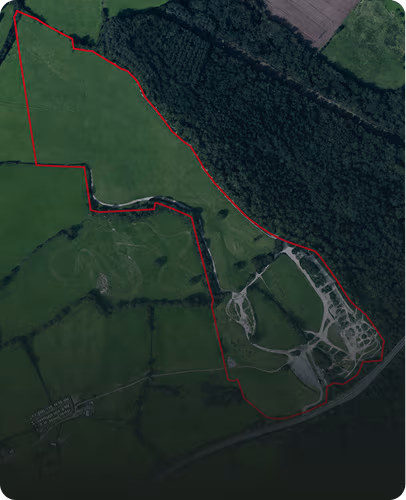
Promotion of a constrained 10-acre site through legal, planning and technical complexity.
Site taken from unallocated land to outline planning permission for up to 89 dwellings.
.avif)

Telford, Shropshire
Land Promotion
.svg)
You can, and some landowners do. The challenge is that planning is only one part of the process. It requires coordination across multiple technical disciplines, upfront funding, and a clear strategy from planning through to sale. Most individual advisers focus on their own area. The outcome depends on how everything is brought together, managed and funded over the full lifecycle. That's the gap we fill.
We only take on sites where we see a clear and realistic path to securing planning permission. That said, planning is never guaranteed. If an application is refused, we assess the reasons, engage with the local authority and determine the best next step, whether that's a revised scheme or an appeal. All of that sits with us, including the cost. You are not exposed to additional funding or risk if further work is required.
Most sites take between 1 and 3 years. This includes early-stage work, surveys, design, the planning application and often a period of negotiation with the local authority. If an appeal is required, it can take longer. Some sites are more strategic in nature and may require a longer-term approach, typically 5–10 years. In those cases, we agree a clear strategy for how the site will be progressed over time. In all cases, the objective is the same. We move the process forward as efficiently as possible to reach a successful outcome.
No. We appoint and manage all consultants, coordinate the process, deal with the planning authority and handle the commercial side through to sale. You are kept informed at key points, but you are not expected to run or manage the process day-to-day.
That is shaped through the planning process, not decided upfront in isolation. We design a scheme based on what the local authority is likely to support, what the site can physically accommodate, and what the market will pay for. The goal is not just to get permission, but to secure the type and scale of development that maximises the land value at sale.
Yes, particularly at the early strategy stage. We agree on the overall direction with you before progressing. If you have strong preferences, we take those into account and, where possible, look to accommodate them. From there, decisions are guided by planning policy, technical constraints and commercial viability. The strongest outcomes come from balancing your preferences with what is most likely to be approved and deliver the best result.
That depends on the site.
Before moving forward, we carry out a detailed review of planning policy, surrounding development, constraints and the local authority’s position. We only take on sites where we believe there is a very high likelihood of securing planning permission, and our track record reflects that.
If there isn’t a credible path to planning, we won’t proceed. This only works where there is a strong opportunity to create value.
Yes. Planning is a public process.
Once an application is submitted, the local authority will notify neighbours and relevant stakeholders, and the application will be publicly accessible.
In many cases, we engage with local residents in advance of submission to introduce the scheme and address concerns early, helping to smooth the process and reduce objections.
You can, but you will almost always be selling at a significantly lower value. Without planning, buyers price in risk, uncertainty and their own profit margin for securing permission. With planning in place, that risk is removed and the land becomes far more valuable and marketable. The difference can be substantial.
Payment is typically received once planning has been secured and the land is ready for sale or transfer. This is when the uplift in value created through the planning process is realised.
That depends on your personal circumstances and how the land is held. We're not tax advisers, but we regularly work alongside specialists who can structure things appropriately and ensure you understand the position before any sale completes.
No. The land remains in your name at all times. We work under a legal agreement that allows us to secure planning permission and maximise the value of your land before it is sold on the open market. You retain ownership throughout. We focus on creating the uplift in value.
Get an initial assessment of your land's potential value, with clear guidance on next steps.
.svg)